 |
bostonbubble.com
Boston Bubble - Boston Real Estate Analysis
|
|
SPONSORED LINKS
Advertise on Boston Bubble
Buyer brokers and motivated
sellers, reach potential buyers.
www.bostonbubble.com
YOUR AD HERE
|
|
DISCLAIMER: The information provided on this website and in the
associated forums comes with ABSOLUTELY NO WARRANTY, expressed
or implied. You assume all risk for your own use of the information
provided as the accuracy of the information is in no way guaranteed.
As always, cross check information that you would deem useful against
multiple, reliable, independent resources. The opinions expressed
belong to the individual authors and not necessarily to other parties.
|
| View previous topic :: View next topic |
| Author |
Message |
admin
Site Admin
Joined: 14 Jul 2005
Posts: 1826
Location: Greater Boston
|
 Posted: Thu Aug 26, 2010 11:29 pm GMT Post subject: Boston Bubble Wrap: The Real Story for MA - Jul 2010 Posted: Thu Aug 26, 2010 11:29 pm GMT Post subject: Boston Bubble Wrap: The Real Story for MA - Jul 2010 |
 |
|
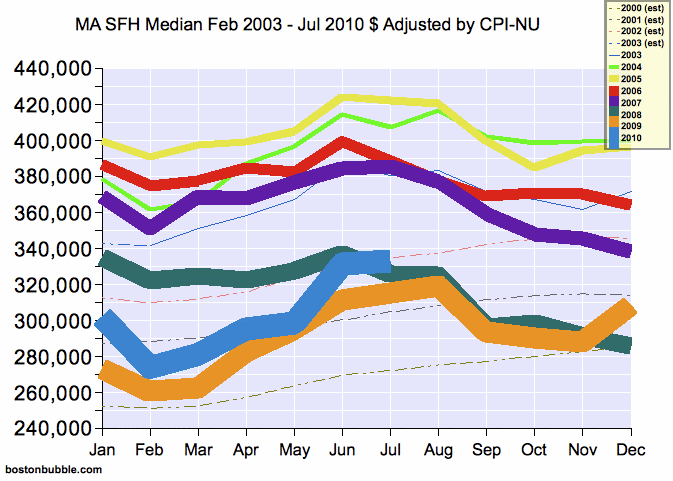
This is a brief report on what the data for the housing market in Massachusetts looks like in real terms. Market data is typically reported in nominal terms which can be misleading because it combines changes in housing values with changes in the value of the dollar. Correcting for inflation removes changes in the dollar as a factor and gives a more accurate picture of how housing values have changed. This report is based on the published data of the Massachusetts Association of Realtors, though it should be noted that the S&P/Case-Shiller Index is a superior data source.
The Massachusetts Association of Realtors released their data for July 2010 on Tuesday, August 24th. While the raw prices were provided in nominal terms, for this report they have been adjusted for inflation using the CPI Northeast Urban numbers available at http://www.bls.gov/cpi/ Adjusting for inflation produced the data represented by the graphs below. Prices for January 2003 and earlier have been estimated by applying the earliest reported median from The MAR, February 2003, against the S&P/Case-Shiller Index for the Boston area. Suggestions for improving this estimate are welcome.
Full Price History
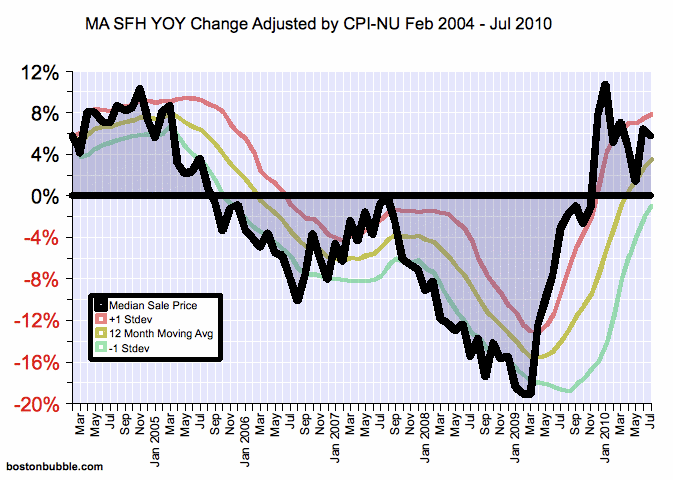
Change in Median Price From One Year Earlier, February 2004 - July 2010
Seasonal variations are removed by comparing prices from the same month in the prior year.
Some observations:
- The real increase from July 2009 to July 2010 was 5.71%.
- This was the eighth real year over year increase since August 2005, with all such increases occurring consecutively and after the most recent renewal and expansion of the home buyer tax credit.
- Real prices are still lower than the same month in every year in the time period covered by The MAR, with the exception of 2008 and 2009.
- This is the first time that the median has been above the real median for the same month in 2008 since falling below it. The difference was slight, however.
- Prices are now 21.45% below the peak set in June 2005. This is the result of a 10.90% decline in nominal housing prices and a 11.84% decline in the purchasing power of the dollar.
- The cumulative price decline from the beginning (Feb 2003) is 2.52%, which is an annualized decline of 0.34%.
Of note in this month's Massachusetts Association of Realtors report, sales volume for single family homes plunged 28% from one year earlier. No doubt this had much to do with the original closing deadline for the most recent home buyer tax credit expansion. While the closing deadline has since been extended to the end of September, it had originally been the end of June, and that extension came late enough to have already stolen sales from future months which are now covered by the extension. On the other hand, the credit will likely also add some sales to what otherwise would have occurred through the end of September as The MAR reported that 47% of members reported that they had at least one client who benefited from the extension, and 18% had at least three clients who benefited. Consequently, the tax credit will probably be distorting the volume data in both directions for the next several months, though it would seem from the precipitous drop that the net effect is downward.
Similarly, price is still being distorted by the credit. It is pushed up by the stragglers taking advantage of the credit, but it is also pushed down by the lower demand resulting from the void left by the time shifted sales. More importantly, the volume was so dramatically lower this month that the median price is probably not a particularly reliable gage at present. The increase in the median could very well be due to fewer low-end homes being sold even while the price on high-end homes stays flat or even declines.
The S&P/Case-Shiller Index for Boston is likely superior to the data above as it corrects for many flaws that are inherent when using only the median price. The S&P/Case-Shiller Index also has the advantage that futures contracts can be traded against it, thereby offering an unbiased insight into where housing prices are expected to be in the future. It also has more extensive historical data available. The MAR data was used for this report mainly out of inertia and might be replaced with the S&P/Case-Shiller Index in future reports.
As usual, please do try this at home. Double checking of the math used to construct the above graphs and analysis is strongly encouraged in order to help ferret out any errors. The data was derived from the following sources:
The text of this post and the associated graphs are Copyright 2010 by bostonbubble.com with all rights reserved, except as stated here. You may reproduce each graph individually or the text of the entire post as a whole (including graphs) under the Creative Commons Attribution-No Derivative Works 3.0 Unported License. You may additionally scale the graphs to fit your work. Alternatively, if you remove the bostonbubble.com signature from the bottom left hand corner of the images within this post, those modified images (and only those modified images) can then be distributed under the Creative Commons Attribution 3.0 Unported License. In all cases, attribution should be made via a hyperlink to http://www.bostonbubble.com/forums/viewtopic.php?t=2989 or http://www.bostonbubble.com/ Quoting excerpts of the text is also allowed provided that the quotes would normally fall under fair use. To request other terms for reproduction, please post your request in the original thread at http://www.bostonbubble.com/forums/viewtopic.php?t=2989
The latest version of this report can be found at http://www.bostonbubble.com/latest.php?id=ma_inflation
- admin |
|
| Back to top |
|
 |
mpr
Joined: 06 Jun 2009
Posts: 344
|
| Posted: Fri Aug 27, 2010 12:40 pm GMT Post subject: |
|
|
Can the CS data be skewed by a change in the composition by price range
of houses sold ? I thought it tracked serial sales of the same house,
and so this shouldn't effect it as much. |
|
| Back to top |
|
|
admin
Site Admin
Joined: 14 Jul 2005
Posts: 1826
Location: Greater Boston
|
| Posted: Fri Aug 27, 2010 1:49 pm GMT Post subject: |
|
|
| mpr wrote: | Can the CS data be skewed by a change in the composition by price range
of houses sold ? I thought it tracked serial sales of the same house,
and so this shouldn't effect it as much. |
The S&P/Case-Shiller Index is much less vulnerable to being skewed by a change in the mix of what is selling because, as you pointed out, it chains together same-home sales. I would expect that there are still scenarios where a change in the mix would cause a skew, but I haven't studied their formula enough to know for sure. I think that the tiered indexes would definitely be affected by a change in the mix because the tiers are taken as the top, middle, and bottom third of all sales from each time period.
- admin |
|
| Back to top |
|
|
john p
Joined: 10 Mar 2006
Posts: 1820
|
| Posted: Fri Aug 27, 2010 3:02 pm GMT Post subject: |
|
|
This is a good question, it's got me thinking....
Let's say that Mr. Smith bought his house in 1982 and sold in 2010, that would be the "matched pair" that Case Shiller would plug into their Index.
I think if I had the time and the tools, I would try to break down current sales and see what years they matched back to. If you saw a predominance of babyboomers that bought say in the late 1970's you could get a sense as to how those transactions behaved versus say a rash of home sales due to defaults because the matched pair was a foreclosure.
http://en.wikipedia.org/wiki/Couple_(mechanics)
In mechanics, they have these things called "couples" which are similar to the "matched pair" because they are similar value (minus fatigue) and the delta is the measure of price appreciation. You can read the section regarding torque which is almost like the acceleration and velocity, which is what I see as the measure of Case Shiller.
This is how I see the distortions in the velocity:
http://www.youtube.com/watch?v=qv-xKabxtGE |
|
| Back to top |
|
|
balor123
Joined: 08 Mar 2008
Posts: 1204
|
| Posted: Fri Aug 27, 2010 4:44 pm GMT Post subject: |
|
|
Tools are a piece of cake. Data is tough. If we had the data, then we could come up with other interesting graphs like:
1. Estimated value pairs
2. Asking price pairs
3. Pairs by time since purchase
4. Pairs by time since first purchase
5. Pairs by homeowner age
6. Pairs by income or by price segment |
|
| Back to top |
|
|
john p
Joined: 10 Mar 2006
Posts: 1820
|
|
| Back to top |
|
|
Guest
|
| Posted: Mon Sep 20, 2010 3:37 pm GMT Post subject: |
|
|
| The problem with tiers and CS is that the top tier was once say $750k+ and is now $450k+, the latter now including a much larger range of prices, so it becomes harder to see what it going on in higher end. |
|
| Back to top |
|
|
Renting in Mass
Joined: 26 Jun 2008
Posts: 381
Location: In a house I bought in December 2011
|
| Posted: Mon Sep 20, 2010 3:58 pm GMT Post subject: |
|
|
| It seems crazy to me that prices are only 10.9 percent lower (nominal) than they were at the 2005 peak. Weren't prices up over 100% in 5 years at that point? When we hear that Nevada is down 60%, that's nominal, right? |
|
| Back to top |
|
|
admin
Site Admin
Joined: 14 Jul 2005
Posts: 1826
Location: Greater Boston
|
| Posted: Mon Sep 20, 2010 5:44 pm GMT Post subject: |
|
|
| Renting in Mass wrote: | | It seems crazy to me that prices are only 10.9 percent lower (nominal) than they were at the 2005 peak. Weren't prices up over 100% in 5 years at that point? When we hear that Nevada is down 60%, that's nominal, right? |
Some of that increase was due to inflation as is some of the current fall. I wouldn't expect the nominal decline to match the previous nominal increase since inflation is continually occurring and working in opposite directions with respect to those two numbers. Also, bear in mind that a 100% increase would be wiped out by a 50% decline, so the percentages going up will necessarily seem larger than the equivalent percentages going down.
Also, the charts above are for the median. It was Shiller's (superior) chained-sale index which was up ~100% nationally.
- admin |
|
| Back to top |
|
|
Renting in Mass
Joined: 26 Jun 2008
Posts: 381
Location: In a house I bought in December 2011
|
| Posted: Mon Sep 20, 2010 6:36 pm GMT Post subject: |
|
|
| Admin, I remember a thread long ago where you defined some metrics you had in mind that would make you comfortable with buying when they got to a certain level. Where are we at with those. Any closer? |
|
| Back to top |
|
|
GenXer
Joined: 20 Feb 2009
Posts: 703
|
| Posted: Tue Sep 21, 2010 11:42 am GMT Post subject: |
|
|
| Renting in Mass wrote: | | Admin, I remember a thread long ago where you defined some metrics you had in mind that would make you comfortable with buying when they got to a certain level. Where are we at with those. Any closer? |
I would still argue that the only metrics that matter are those of your own. A so-called 'fair' price is only as affordable as your finances make it. Some people can afford more than others, therefore the only metrics one needs is to make sure that personal finances are in order to afford whatever house you are trying to buy. This is mostly to ensure that the risk of falling property values and having to move because of job losses are mitigated. It doesn't matter what the price is if a job loss and/or falling prices will make you lose your investment (remember, you are leveraged at least 5:1). |
|
| Back to top |
|
|
GenXer
Joined: 20 Feb 2009
Posts: 703
|
| Posted: Tue Sep 21, 2010 12:11 pm GMT Post subject: |
|
|
Just a note. For a Pareto-type distribution (i.e. assymptotic tail distribution which can describe the extreme moves that we observe from the data), the MEAN is given by alpha*x/(alpha-1) for alpha > 1, and the MEDIAN is given by 2^(1/alpha)*x, where alpha is the tail exponent. For the real estate data it is fair to assume a tail exponent between 1 and 3 (i.e. we can't really estimate it accurately because the data doesn't let us - we don't have enough data). Typically, the literature finds that the exponents range from 2 to 3.
Here's a reference on Pareto distribution:
http://en.wikipedia.org/wiki/Pareto_distribution
It is called an 80-20 distribution for a reason. If we look at income distribution, they have roughly an 80-20 distribution (or something similar). I don't claim that the real estate prices have this distribution, but the TAIL (i.e. the most extreme deviations) have this type of distribution. I've plotted Case Schiller index before, and even though the data is lacking, we can see that the tail of the distribution has a Pareto-type tail (i.e. straight line on a log-log plot).
If we actually look at the MEAN vs. the MEDIAN, the mean varies from being an ORDER of magnitude larger than the MEDIAN for alpha ~ 1, down to about 1.2 times the median for alpha = 3. Do the math yourself - divide the mean by the median, and let alpha vary from 1.01 to 3.
Why is this important? Well, if we are going for the MEDIAN, and the mean is actually MUCH larger, especially under extreme circumstances, like now, we are UNDERESTIMATING by close to an order of magnitude the response of the market (i.e. the price change). Something else to consider when using Case Schiller index. Also, this result makes the median price useless, as far as I'm concerned. |
|
| Back to top |
|
|
Renting in Mass
Joined: 26 Jun 2008
Posts: 381
Location: In a house I bought in December 2011
|
| Posted: Tue Sep 21, 2010 12:49 pm GMT Post subject: |
|
|
| Quote: | | therefore the only metrics one needs is to make sure that personal finances are in order to afford whatever house you are trying to buy. This is mostly to ensure that the risk of falling property values and having to move because of job losses are mitigated. It doesn't matter what the price is if a job loss and/or falling prices will make you lose your investment. |
What I can afford to lose and what I'm willing to lose are two different things. I'm not worried about losing my house. I'm worried about losing my 20% down.[/quote] |
|
| Back to top |
|
|
GenXer
Joined: 20 Feb 2009
Posts: 703
|
| Posted: Tue Sep 21, 2010 1:40 pm GMT Post subject: |
|
|
| Renting in Mass wrote: | | Quote: | | therefore the only metrics one needs is to make sure that personal finances are in order to afford whatever house you are trying to buy. This is mostly to ensure that the risk of falling property values and having to move because of job losses are mitigated. It doesn't matter what the price is if a job loss and/or falling prices will make you lose your investment. |
What I can afford to lose and what I'm willing to lose are two different things. I'm not worried about losing my house. I'm worried about losing my 20% down. |
[/quote]
Exactly. I'm not saying the price doesn't matter. It does to a point. Its the leverage that gets you. This is why I'm arguing that you should be able to AFFORD to lose a fraction of the house price without significant impact on your finances. This means minimizing leverage. This leads to much lower prices (i.e. much larger downpayments, and hence lower prices that one can afford). Of course, 20% of 300k is not the same as 20% of 800k. This is why it all depends on your finances. Having to sell at a loss shouldn't bankrupt you - that is, if you have to move to a new job, you should be able to do it no problem (vs. bleeding for years, trying to rent the house out, and losing money that way, while prices are still going down, hence losing even more in the long run).
This is not a simple calculation. You will need to look at different scenarios. Worst case is that you have to sell tomorrow. Another case is that you can rent it out, and take some losses. But always, you'll have to be able to afford doing all of that if you and/or your spouse loses their jobs. Can you make payments on 2 unemployment checks (worst case) and for how long? This will severely limit your price range, in my opinion. And of course, your risk of loss (and the very real risk of foreclosure). |
|
| Back to top |
|
|
GenXer
Joined: 20 Feb 2009
Posts: 703
|
| Posted: Tue Sep 21, 2010 1:51 pm GMT Post subject: |
|
|
| I didn't mean to be confusing in my 'median prices don't mean much' post. The idea is simple. For an extreme type of deviation that we've been observing in the housing market prices, a 'fatter' tailed distribution has a mean that is located further away from the median (closer to the tail) simply because more of the distribution is in the tail. That's all I was trying to say. And because we don't really have a way of estimating the real tail behavior (not much data), we have NO WAY of knowning how far our median values are from the mean values, leading to potentially HUGE errrors (as much as an order of magnitude). So take the median prices with a grain of salt. They can be severely UNDERESTIMATING the real prices. |
|
| Back to top |
|
|
|
|
You can post new topics in this forum
You can reply to topics in this forum
You cannot edit your posts in this forum
You cannot delete your posts in this forum
You cannot vote in polls in this forum
|
Forum posts are owned by the original posters.
Forum boards are Copyright 2005 - present, bostonbubble.com.
Privacy policy in effect.
Powered by phpBB © 2001, 2005 phpBB Group
|
 FAQ
FAQ Search
 Memberlist
 Usergroups
 Register
 Profile
 Log in to check your private messages
 Log in


